The Real Giant Raptor
When people think of 'raptors,' they usually picture the Velociraptors of Jurassic Park — human-sized, intelligent, deadly. But the real Velociraptor was only about the size of a turkey. The true giant of the dromaeosaur family was Utahraptor ostrommaysi — a 5-7 meter long, half-ton predator that was basically the real-world version of the movie raptors. Utahraptor is a fantastic species for animatronic displays because it delivers all the 'giant raptor' drama that people expect, but with genuine scientific credibility.
Utahraptor Biology
Utahraptor is the largest known dromaeosaurid — the group of 'raptor' dinosaurs famous for their sickle claws:
- Size: 5-7 meters long, 1.8-2 meters tall at the hips, and 250-500 kg. About the size of a polar bear — far larger than Velociraptor.
- Sickle claw: The signature dromaeosaur killing claw on the second toe — up to 22 cm long in Utahraptor (bigger than a human hand).
- Time and place: Early Cretaceous, about 135-130 million years ago, in what is now Utah, USA. Much earlier than Velociraptor and T-Rex.
- Feathers: Like other dromaeosaurs, Utahraptor was almost certainly feathered, though we do not have direct feather evidence for this specific species yet.
- Built for power: Utahraptor was stocky and robust — more like a grizzly bear than the sleek, agile Velociraptor. It was an ambush predator built for power, not speed.
- Pack hunter?: Utahraptor may have hunted in packs, though the evidence is debated. Regardless, pack displays are very popular.
How Utahraptor Differs from Velociraptor
Utahraptor and Velociraptor are both dromaeosaurs, but they are very different animals:
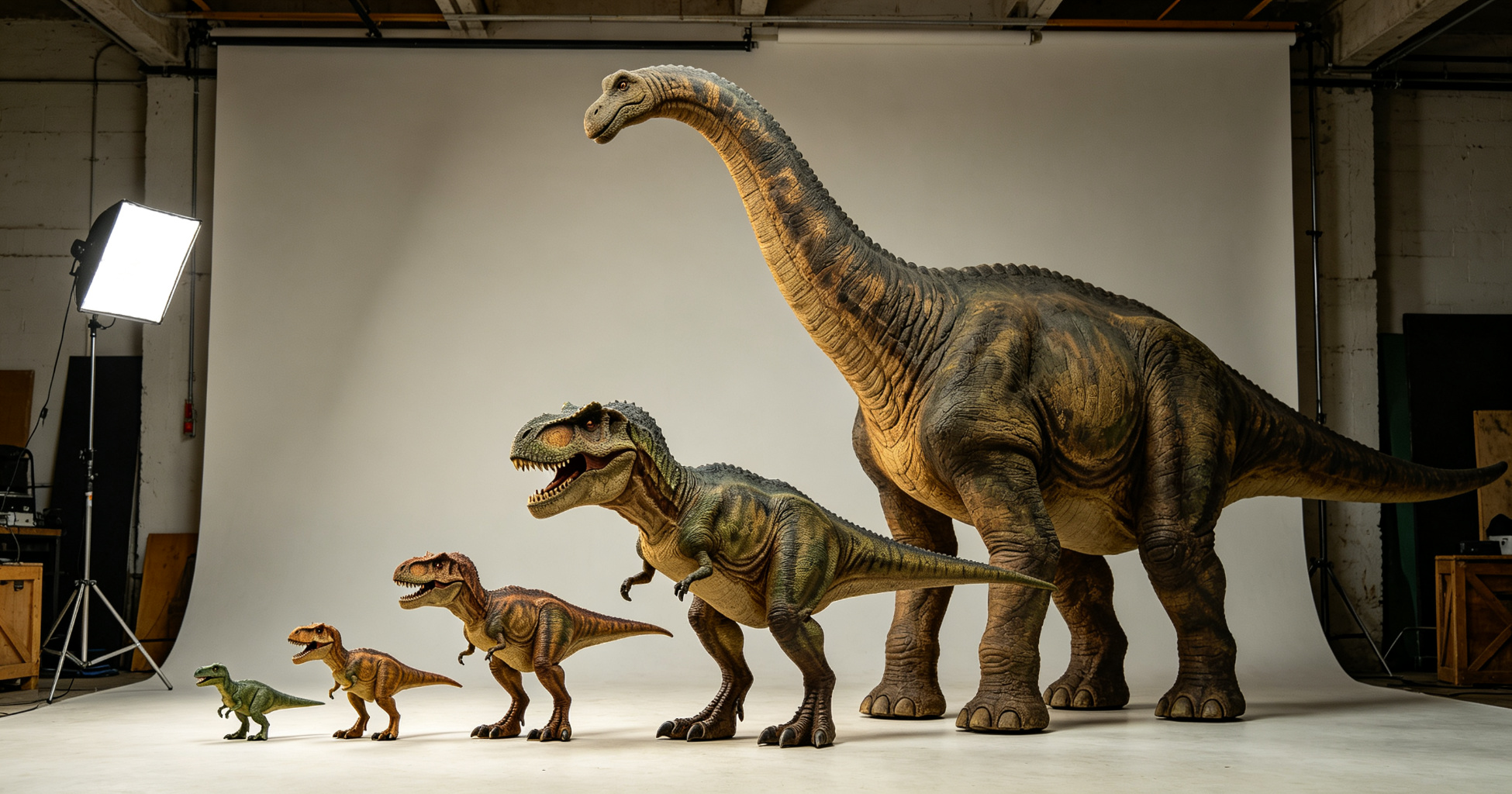
- Size: Utahraptor was 3-5 times larger than Velociraptor by weight. A Velociraptor was roughly turkey-sized; a Utahraptor was bear-sized.
- Time period: Utahraptor lived in the Early Cretaceous (135 mya); Velociraptor lived in the Late Cretaceous (75-71 mya). They were separated by 60+ million years — more time than separates us from T-Rex.
- Geography: Utahraptor is from North America; Velociraptor is from Mongolia and China.
- Build: Utahraptor was robust, stocky, and powerful — a brute-force ambush predator. Velociraptor was smaller, lighter, and more agile.
- Cultural status: Velociraptor is far more famous thanks to films, but Utahraptor is the real 'giant raptor' that most people think Velociraptor was.
Why Utahraptor Is a Great Attraction Animal
Utahraptor fills a unique niche in dinosaur attractions:
- The 'real giant raptor': People love the big movie raptors. Utahraptor is the real thing — a scientifically valid dinosaur that matches the size and ferocity people expect from 'raptors'.
- Novelty factor: Most venues have Velociraptor. Far fewer have Utahraptor. Dinosaur fans will travel to see a giant raptor species they have never seen in person.
- Perfect size: Big enough to be genuinely imposing and impressive, but not so big that it requires enormous space or massive infrastructure.
- Dynamic poses: Utahraptor's size makes dynamic action poses like leaping and pouncing really work — the scale makes the action feel powerful and real.
- Great for both fear and fascination: Utahraptor is intimidating enough for thrill-seekers but interesting enough from a science perspective for educational venues.
Signature Poses and Displays
Utahraptor excels at dynamic, action-oriented poses:
- Leaping / pouncing pose: The Utahraptor is caught mid-leap, claws extended, as if launching onto prey. This is the most dramatic and popular pose — the long leap and open claws create a powerful visual.
- Canyon / rock pose: Perched on rocks or a canyon edge, surveying its territory. Utahraptor is named after Utah, and canyon/rock environments are strongly associated with it.
- Pack display: 2-4 Utahraptors working together. Given their size, a pack of Utahraptors is genuinely terrifying and impressive.
- Killing pose: Utahraptor on top of prey, sickle claws deployed. Dramatic and educational — shows how dromaeosaurs may have used their famous claws.
- Ambush pose: Partially hidden behind rocks or foliage, ready to strike. Great for walk-through exhibits where the raptor is a reveal.
Movement Options
Utahraptor animatronics have unique movement capabilities:
- Full body lunge / pounce: The signature movement — the whole body leans or springs forward in a pouncing motion.
- Arm / claw movement: Powerful arm movements with grasping hands and claw extension.
- Head movement: Fast, sharp head turns — raptors are known for their alert, active head movement.
- Mouth open/close with snarls and hisses — deep, powerful sounds for a big raptor
- Sickle claw movement: The killing claw on the foot raises and lowers — ready to strike.
- Body shift and weight transfer: Subtle shifting from foot to foot, like a predator tensing before a strike.
- Tail movement: Long, stiffened tail used for balance — sways and adjusts as the animal moves.
- Eyes blink and focus: Quick, alert blinks and eye tracking.
Pack Display Design
Utahraptor packs are stunning and can be designed in several ways:
- Ambush team: Two or three raptors positioned around a path or walkway — different angles, different heights. As visitors walk through, different raptors are revealed at different points.
- Hunting pack: All raptors focused on a shared target (a prey item or a direction). Creates the impression of coordinated hunting.
- Hierarchical: A large, dominant alpha in the prime position, with smaller subordinates in supporting positions. Tells a story about social structure.
- Coordinated programming: All raptors in the pack share a controller, so their movements are coordinated — one raptor alerts, another moves to flank, the third strikes. Creates believable group behavior.
Size Ranges and Pricing
Utahraptor animatronics are available in multiple sizes:
- Small (2-3m): Sub-adult or compact models for indoor venues and tight spaces. Budget: $3,000 - $7,000.
- Medium (4-5m): Life-size or near-life-size adult Utahraptor. The most popular size. Budget: $8,000 - $18,000.
- Large (6-7m): Full-size adult Utahraptor with maximum dramatic impact. Budget: $20,000 - $38,000.
- Pack pricing: Multi-raptor packs are available at a volume discount. Contact SAGE for pack pricing.
Ready to Add Giant Raptors to Your Attraction?
Utahraptor is one of the most exciting dinosaur species you can add to an attraction right now. It delivers all the raptor drama people love, but at a scale and quality that genuinely surprises them. Browse SAGE's Utahraptor lineup or contact our team for custom pack display design.