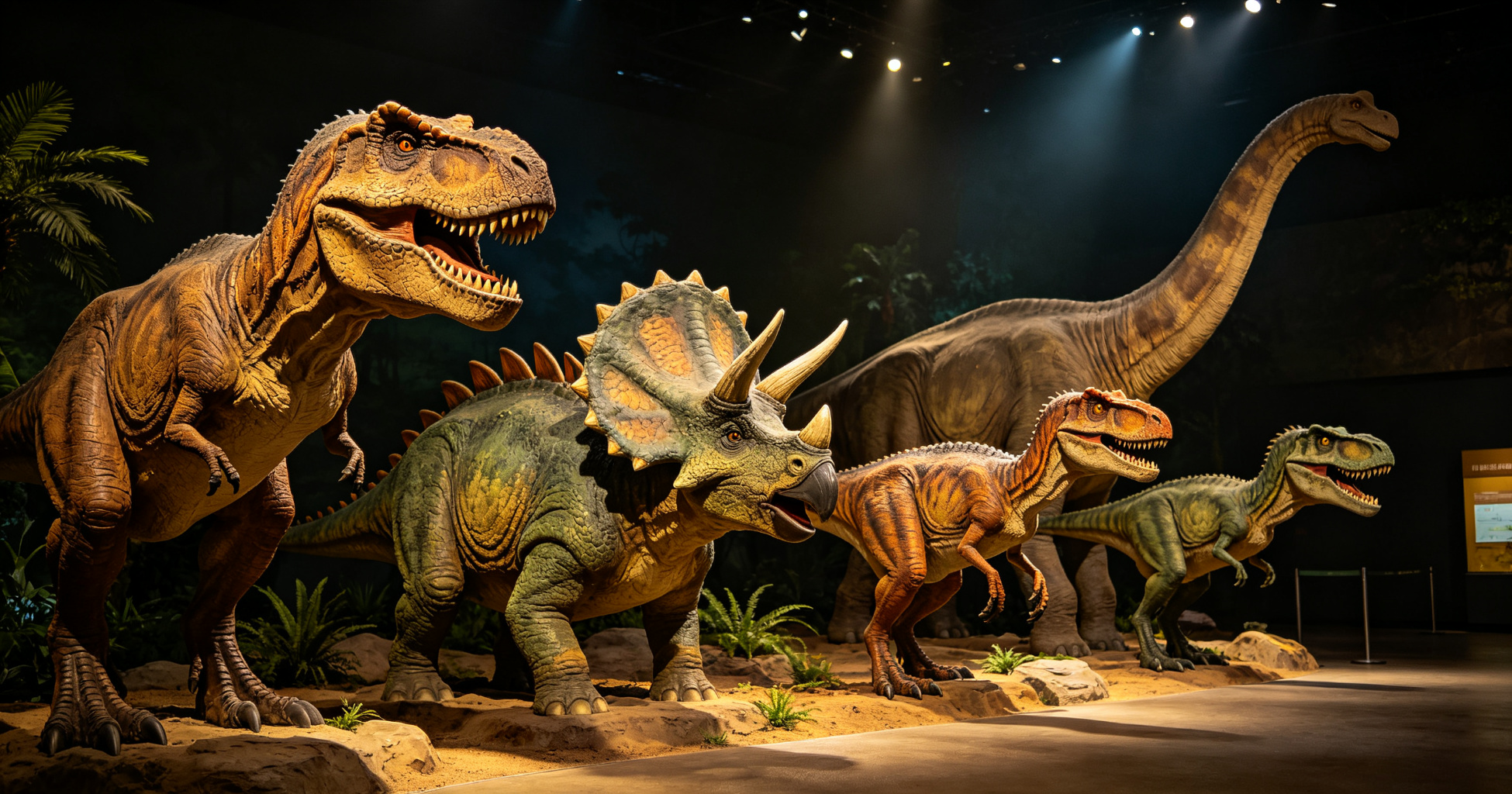
The movement system is the heart and soul of an animatronic dinosaur. It is what turns a sculpture into a living, breathing creature. But not all movement systems are the same. There are three primary technologies used in animatronic dinosaurs — electric servo motors, hydraulics, and pneumatics — each with different strengths, weaknesses, and ideal applications.
Understanding how these systems work, and why a manufacturer chooses one over another, will help you make a more informed buying decision. It will also help you maintain the system properly and diagnose problems when they occur.
Electric Servo Motors: The Modern Standard
Electric servo motors are the most common actuation technology in modern animatronic dinosaurs, and for good reason. A servo motor is a precision electric motor with built-in position feedback — the controller tells it exactly what position to go to, and it goes there, with constant feedback to ensure accuracy.
How It Works
Each movement point (neck, mouth, tail, eyes, etc.) is driven by its own servo motor. The motor connects to the moving part through a combination of drive chains, gearboxes, levers, and cables. The motor's internal encoder tells the controller exactly what angle the motor is at, and the controller adjusts power to get it to the desired position.
All of the dinosaur's servos are coordinated by a central controller (usually a PLC or dedicated motion controller) that runs pre-programmed motion sequences. The controller ensures that all movements are timed correctly — so the mouth opens and the roar sound plays at exactly the same moment, the body shifts weight as the tail swings, and so on.
Advantages of Electric Servos
- Precision: Servo motors can position with extremely high accuracy — within a fraction of a degree. This allows for very smooth, natural-looking movement.
- Repeatability: The movement is exactly the same every time, cycle after cycle. No drift, no variation.
- Programming flexibility: Motion sequences are programmed in software and can be changed, updated, or customized without mechanical modifications.
- Clean and simple: No hydraulic fluid, no air compressors, no hoses. Just wires and motors. Much easier to install and maintain.
- Energy efficient: Electric motors only draw power when they are actually moving. They are much more efficient than hydraulic or pneumatic systems that run continuously.
- Low noise: Modern servo motors are very quiet — much quieter than hydraulic pumps or pneumatic hiss.
- Safe: No high-pressure fluid lines or compressed air that can fail catastrophically.
Disadvantages of Electric Servos
- Lower force-to-size ratio: For very heavy movements (like lifting a giant sauropod neck), you need very large motors. There comes a point where hydraulic systems become more compact for the same force.
- Heat generation: Electric motors generate heat, especially under heavy load. For high-duty-cycle applications, motors may need additional cooling.
- More complex electronics: Servo systems require motor controllers/drivers for each motor, which means more electronic components that can fail.
- Cost for high-force applications: For very large, heavy dinosaurs, electric servo systems can be more expensive than hydraulic equivalents.
Best for:
Small to large dinosaurs (up to about 18m) where precision, smoothness, and reliability are priorities. This is SAGE's standard technology for 90% of our dinosaur models.
Hydraulic Systems: Power and Force
Hydraulic systems use pressurized fluid (usually mineral oil) to transmit force. A central hydraulic pump provides pressure, and control valves direct fluid to hydraulic cylinders that produce linear movement. Hydraulics are the powerhouse of animatronics — used when you need massive force in a compact package.
How It Works
A central hydraulic power unit (HPU) — consisting of a pump, motor, reservoir, and pressure regulator — supplies pressurized hydraulic fluid to the dinosaur. Each movement is driven by a hydraulic cylinder, controlled by a servo valve that precisely meters fluid flow. The position of the cylinder is monitored by a position sensor, and the controller adjusts the valve to achieve the desired movement.
Hydraulic systems are very powerful. A 2-inch diameter hydraulic cylinder at 2,000 psi can generate over 6,000 pounds of force — far more than an electric motor of similar size.
Advantages of Hydraulics
- Enormous force: Hydraulics produce more force per unit size than any other actuation technology. They are the go-to choice for very large, heavy dinosaurs.
- Smooth power: Hydraulic movement is extremely smooth and fluid — literally. The compressibility of the oil gives a natural "give" that feels organic and animal-like.
- Constant force: Hydraulic cylinders produce consistent force throughout their entire stroke, unlike electric motors where torque varies with speed.
- Compact for high force: For heavy movements, hydraulic cylinders are much more compact than equivalent electric motors and gearboxes.
- Durability under heavy load: Hydraulic systems are very tough and can handle continuous heavy-duty operation better than many electric systems.
Disadvantages of Hydraulics
- Leaks: Hydraulic systems leak. It is not a question of if, but when. Seals wear out, hoses fail, fittings work loose. Hydraulic oil is messy, slippery, and can stain surrounding surfaces.
- Maintenance: Hydraulic systems require more maintenance than electric systems — regular filter changes, fluid testing and replacement, seal replacement, etc.
- Noise: The hydraulic pump makes continuous noise, and the valves can make audible clicks when they operate.
- Energy waste: The hydraulic pump runs continuously even when the dinosaur is not moving, wasting energy and generating heat.
- More complex installation: You have to route hydraulic hoses, deal with fluid filling and bleeding, and install the HPU somewhere with ventilation.
- Fire risk: Hydraulic oil is flammable, and high-pressure leaks can create spray that ignites easily near hot surfaces.
Best for:
Very large dinosaurs (20m+), heavy movements, and applications where raw force is more important than precision and low maintenance. SAGE uses hydraulic systems primarily for giant sauropod necks, very large T-Rex models, and custom projects with special force requirements.
Pneumatic Systems: Fast and Simple
Pneumatic systems use compressed air instead of hydraulic fluid. They were the original animatronic technology (Disney's first Audio-Animatronics were pneumatic) but are less common in modern high-end dinosaur animatronics. They still have their place, however.
How It Works
An air compressor provides compressed air to the dinosaur. Each movement is driven by a pneumatic cylinder controlled by a valve. When the valve opens, air flows into the cylinder and it extends; when it vents, the cylinder retracts (usually with the help of a spring or gravity).
Pneumatic systems are inherently bang-bang — the cylinder is either fully extended, fully retracted, or somewhere in between only while moving. Modern proportional pneumatic valves can achieve intermediate positions, but with less precision than servo motors or hydraulics.
Advantages of Pneumatics
- Fast movement: Pneumatic cylinders move very quickly — great for fast startle scares and quick actions.
- Simple and low cost: Pneumatic systems are the simplest and least expensive actuation technology for basic movements.
- Clean: No hydraulic oil leaks. The "exhaust" is just air. Good for clean environments.
- Safe: Compressed air at typical pressures (80-120 psi) is not as dangerous as high-pressure hydraulics.
- High force for size: Pneumatic cylinders are compact and powerful — though not as powerful as hydraulics.
Disadvantages of Pneumatics
- Low precision: Standard pneumatic systems are on/off — you cannot easily control the exact position or speed of movement. This makes them unsuitable for smooth, natural animal-like motion.
- Noise: Pneumatic systems are noisy — the compressor runs continuously, valves click loudly, and the exhaust air hisses.
- Compressor maintenance: The air compressor requires regular maintenance — filter changes, oil changes, draining the water separator.
- Energy waste: Like hydraulics, the compressor runs even when the dinosaur is not moving, wasting energy.
- Not smooth: Pneumatic movements tend to be jerky and mechanical-looking, not smooth and organic.
Best for:
Budget applications, startle scares in haunted houses, simple repetitive movements, and situations where speed and low cost matter more than smoothness and precision. SAGE rarely uses pure pneumatic systems for our dinosaur models — we find electric servos give much better realism for only moderately higher cost.
Hybrid Systems: The Best of All Worlds
Many modern animatronic dinosaurs use a combination of actuation technologies, each used for what it does best. For example, a giant Brachiosaurus might use:
- Hydraulics for the massive neck and tail (need the force)
- Electric servos for the head, mouth, and eyes (need the precision)
- Pneumatics for special effects like air blasts or spray effects (fast, simple)
Hybrid systems are more complex to design and maintain, but they give you the optimal technology for each specific movement. For very large or premium dinosaurs, the added complexity is worth it.
Maintenance Comparison
How do the three systems compare on maintenance requirements?
- Electric servo: Low maintenance. Keep things clean, lubricate chains occasionally, check connections. Motors and controllers typically last 7-10 years before needing replacement.
- Hydraulic: High maintenance. Regular filter changes, fluid testing, seal replacement, hose inspection, pump maintenance. Expect to spend 5-10% of the system cost per year on maintenance.
- Pneumatic: Medium maintenance. Compressor servicing, valve cleaning, filter changes, seal replacement. Simpler than hydraulics but more maintenance than electric.
This is the primary reason SAGE uses electric servos as our standard technology — they provide the best balance of performance, reliability, and maintenance for the vast majority of applications.
What to Look for in a Movement System
When evaluating a dinosaur's movement system, ask these questions:
- What actuation technology is used, and why?
- How many movement points does it have, and what are they?
- What is the expected lifespan of the motors/actuators?
- How accessible are the components for maintenance and repair?
- Are replacement parts readily available?
- What kind of controller is used, and can motion sequences be updated?
- What is the maintenance schedule and what does it involve?
- What warranty is provided on the mechanical and electrical systems?