The animatronic dinosaur industry has come a long way since Disney's first hydraulic dinosaurs in the 1960s. Today's models are more realistic, more reliable, and more capable than anything that existed just a decade ago. But we are still in the early innings of what is possible. Over the next 5-10 years, advances in AI, robotics, materials science, and immersive technology will transform animatronic dinosaurs in ways we are just beginning to imagine.
At SAGE, we invest heavily in R&D because we believe the future of animatronics is not just about better motors and fancier skins — it is about creating truly intelligent, responsive, and immersive creature experiences that blur the line between machine and living thing. Here is a look at where we think the industry is heading.
AI-Powered Behavior Systems
The biggest change coming to animatronic dinosaurs is artificial intelligence. Today's dinosaurs run pre-programmed sequences — impressive, but always the same. Tomorrow's dinosaurs will behave like real animals — reacting to visitors, making decisions, expressing moods, and never doing the same thing twice.
AI-powered dinosaur systems will use cameras, microphones, and sensors to perceive their environment, then decide how to respond based on trained behavioral models. A Velociraptor might track the most active person in the crowd with its head. A Triceratops might become skittish when too many people crowd around it. A T-Rex might roar challengingly when it "sees" someone looking directly at it.
This is not science fiction. We are already testing early versions of AI behavior systems in our R&D lab. The results are startling — even simple AI makes the dinosaur feel vastly more alive. Visitors respond completely differently to a dinosaur that seems to be paying attention to them specifically versus one that is just running a loop.
The implications for entertainment and education are enormous. AI dinosaurs can be programmed with different "personality" profiles — aggressive, curious, gentle — for different audiences and settings. They can adapt their behavior based on crowd size, time of day, or even the age of the visitors they detect.
Soft Robotics: More Natural Movement
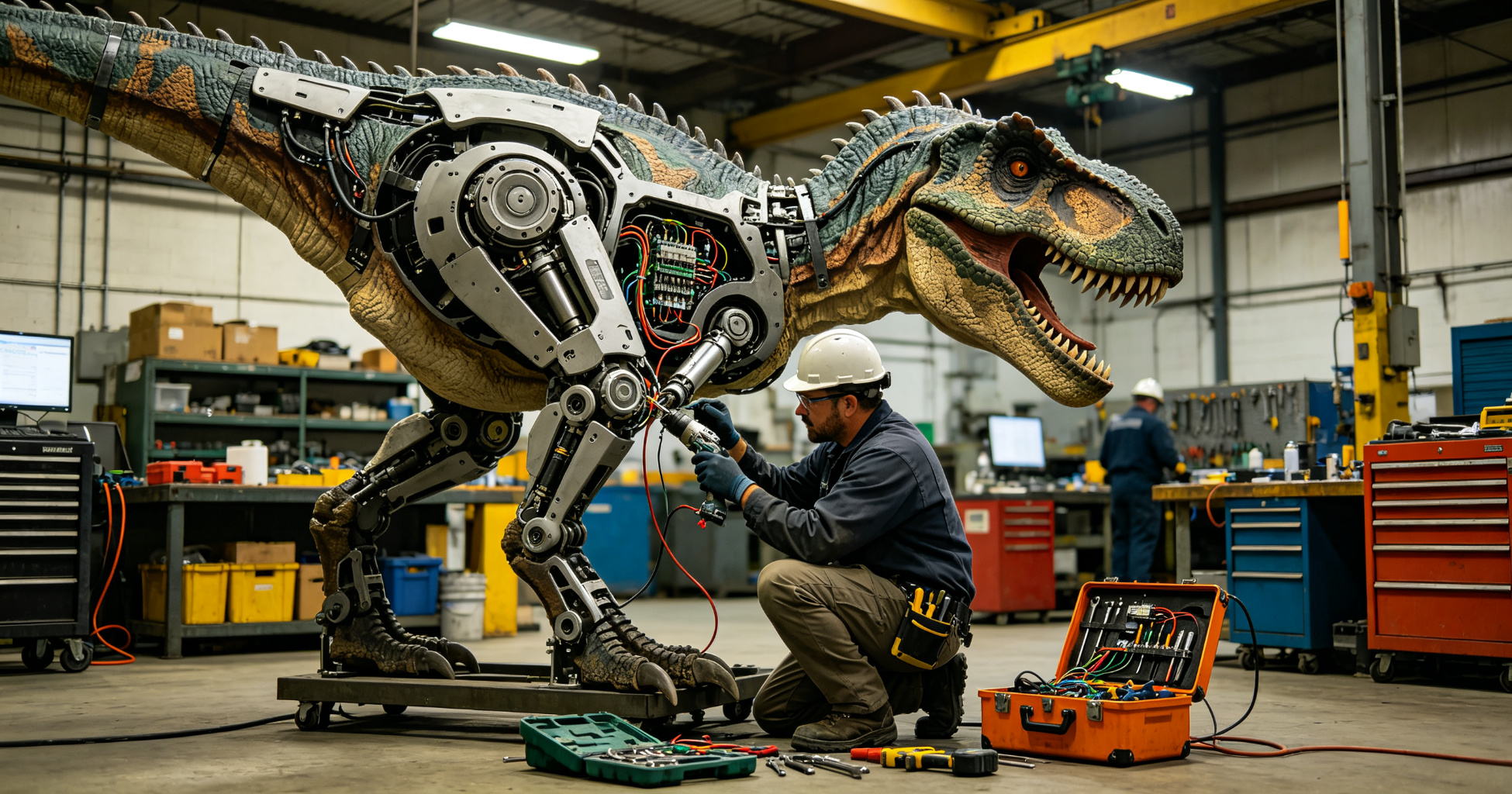
Current animatronic dinosaurs use rigid mechanical systems — motors, gears, chains, rods. These work well, but they have limitations. Real animals have muscles, tendons, and soft tissue that deform, stretch, and move in complex organic ways that rigid mechanics cannot fully replicate.
Soft robotics is an emerging field that uses flexible materials — pneumatics, shape-memory alloys, electroactive polymers, and fluid-filled chambers — to create movement that is much more natural and organic. Instead of a joint rotating on a bearing, a soft robotic muscle contracts like a real muscle, creating smooth, lifelike deformation.
Soft robotics is still in its early days for animatronic applications — current technologies are slow, expensive, and not very durable. But the potential is enormous. In 5-10 years, we expect soft robotic elements to start appearing in premium animatronic dinosaurs — initially for facial expressions and skin movement, eventually for larger muscle groups.
The result will be dinosaurs that look less like machines and more like actual living animals — with skin that ripples, muscles that flex under the surface, and movement that has the subtle give and weight of real flesh and bone.
Haptic and Tactile Feedback
Right now, the experience of an animatronic dinosaur is mostly visual and auditory. You see it, you hear it, maybe you feel the low-frequency rumble. But what if you could also feel it?
Advances in haptic technology will make future dinosaur exhibits multi-sensory experiences. Imagine:
- Touch-sensitive dinosaur skin that feels warm and fleshy — not like silicone
- Interactive exhibits where you can pet a dinosaur and feel it respond
- Floor-mounted haptic systems that rumble when the dinosaur walks
- VR/AR experiences where you can "feel" the dinosaur's roar through a haptic vest
- Wind and spray effects synchronized with movement — you feel the air move as the tail swings past
Haptic feedback adds a physical dimension to the experience that dramatically increases immersion and emotional impact. It turns watching a dinosaur into feeling a dinosaur.
Mixed Reality Integration
The line between physical animatronics and digital effects is going to blur completely. Future dinosaur exhibits will use a combination of real physical dinosaurs and digital overlays to create experiences that would be impossible with either technology alone.
Imagine standing in front of a physical T-Rex animatronic, holding up your phone or wearing AR glasses, and seeing:
- A transparent skeletal overlay showing the dinosaur's bone structure
- Animated information bubbles that pop up when you look at different parts of the dinosaur
- Digital baby dinosaurs running around the physical adult's feet
- The dinosaur's skin changing to show feathered vs. scaly interpretations
- Time-lapse animations showing how the dinosaur was built, layer by layer
- Gamified interactions where you can "feed" the dinosaur or answer questions to make it do tricks
The physical dinosaur provides the presence, scale, and tactile reality. The digital layer provides information, variety, and interactivity. Together they create an experience that is more engaging and more educational than either could be alone.
SAGE is already working on AR integration tools that will make this kind of experience available on standard phones — no special glasses required. Expect to see commercial releases in the next 2-3 years.
Swarm and Group Behavior
Today's animatronic dinosaurs operate mostly as individuals — even when there are multiple dinosaurs in the same exhibit, they are not really aware of each other. Future dinosaur installations will feature networked groups of dinosaurs that interact with each other and coordinate behavior.
Imagine a pack of Velociraptors that truly hunt together — communicating, splitting up, flanking, reacting to each other's positions. Or a herd of Triceratops that move as a group, with individuals watching out for predators and warning each other of danger.
This requires networked control systems, shared sensor data, and AI group behavior algorithms — all technologies that are maturing quickly. Group behavior will dramatically increase the realism and entertainment value of multi-dinosaur exhibits.
Advanced Materials and Self-Repair
Materials science advances will also transform animatronic dinosaurs in the coming years:
- Self-healing skins: Self-healing silicone and polymer materials that can automatically repair small cuts and abrasions — dramatically reducing maintenance and extending skin life.
- Smart skins: Skin with embedded sensors that can detect touch, pressure, and temperature — enabling interactive behavior and also self-diagnosing damage.
- Color-changing materials: Electrochromic and thermochromic materials that can change color dynamically — for displays, mood indicators, or educational demonstrations.
- Bio-based materials: Plant-based foams, mushroom mycelium composites, and other sustainable materials that reduce the environmental impact of manufacturing.
- Nano-coatings: Advanced surface coatings that are self-cleaning, anti-graffiti, and ultra-UV-resistant — making outdoor dinosaurs last longer with less maintenance.
Democratization of Customization
As design and manufacturing technology advances, custom dinosaurs will become faster and cheaper to produce. 3D scanning, digital sculpting, and automated manufacturing will make it possible to create a custom dinosaur in weeks instead of months, and at prices much closer to standard catalog models.
Customers will be able to design their own dinosaurs using web-based configurators — choosing species, size, colors, movement packages, and special features — and see a photorealistic 3D rendering instantly. Production will be largely automated, with humans adding the final artistic touches.
This democratization of customization will make high-quality animatronic dinosaurs accessible to much smaller venues, schools, and organizations that cannot afford custom builds today.
What Will Not Change
For all the technology that is coming, some things will remain the same:
- The fundamental magic of seeing a life-size dinosaur come to life will never go out of style.
- Quality craftsmanship and attention to detail will always matter. Technology is a tool — it still takes human artists and engineers to bring a dinosaur to life.
- Safety will always be paramount. More advanced technology means more things to consider from a safety perspective, not fewer.
- The best dinosaur experiences will always combine multiple senses — sight, sound, motion, and touch — to create something emotionally compelling.
SAGE's Vision for the Future
At SAGE, we are excited about the future. We are investing in AI behavior research, soft robotics prototyping, and mixed reality tools. We are building next-generation control systems that will support these new technologies as they mature. And we are constantly improving our materials and manufacturing processes to make our dinosaurs more durable, more realistic, and more sustainable.
But our core mission remains the same: to bring prehistoric creatures to life in a way that educates, inspires wonder, and creates unforgettable experiences. The technology will change, but that goal never will.
If you are planning a dinosaur attraction and want to incorporate the latest technology — or if you just want a great dinosaur with proven current technology — talk to us. We would love to show you what is possible today and what will be possible tomorrow.