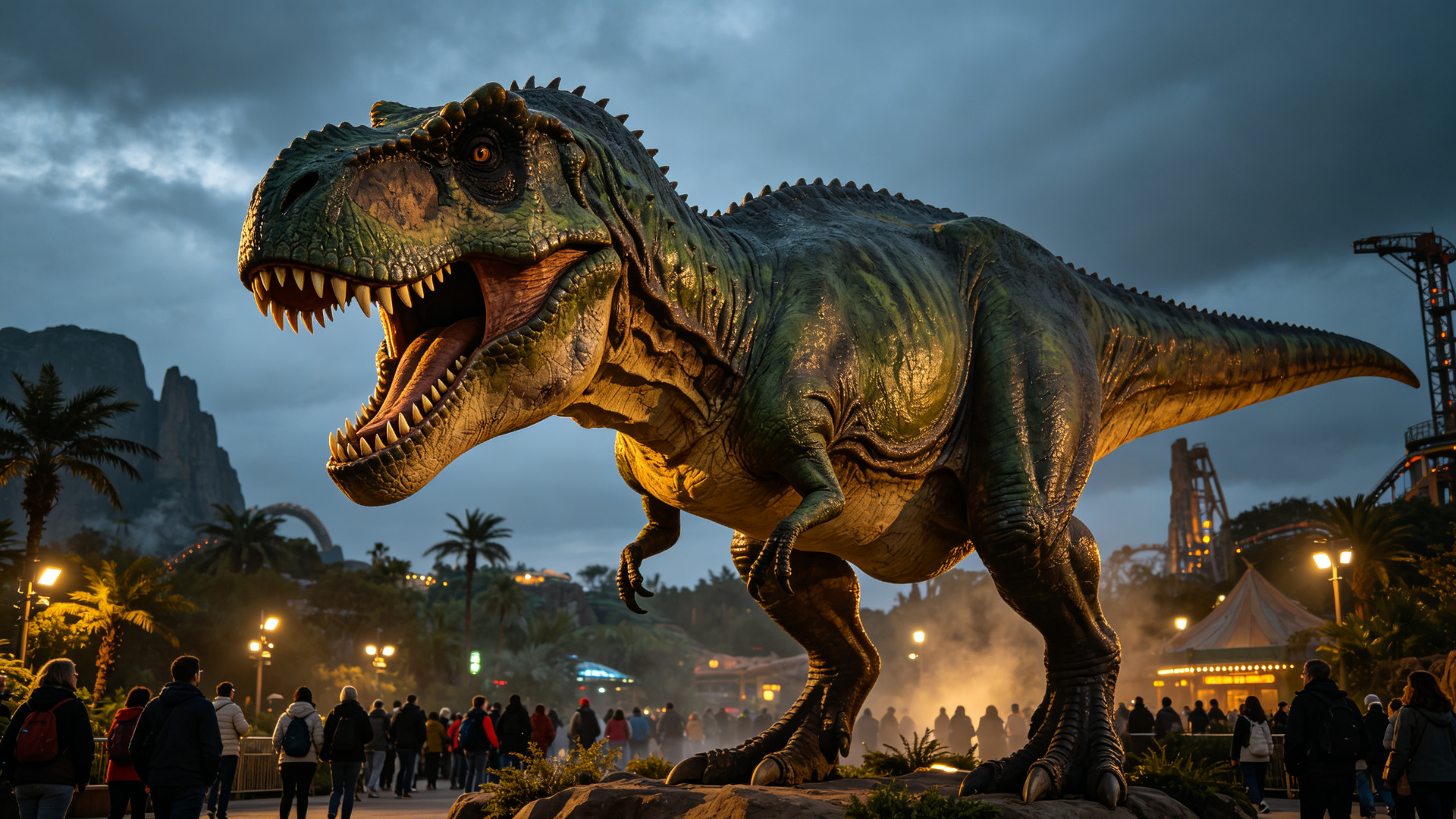
Animatronic shark models bring the ocean's top predator to life with realistic swimming motion, suspended installation, and dramatic underwater lighting. Explore great white shark animatronics, aquarium themes, and ocean predator displays.
The Ocean's Apex Predator
The great white shark is one of the most famous and feared animals on Earth — and an animatronic shark is one of the most dramatic and eye-catching displays you can create. Suspended in mid-air (to simulate swimming in open water) with realistic body movement, a great white shark animatronic is guaranteed to draw crowds. Sharks are perfect for aquariums, oceanariums, science museums, and nautical-themed attractions — combining visual impact with strong educational value about ocean ecosystems and conservation.
Great White Shark Biology
The great white shark (Carcharodon carcharias) is the largest predatory fish on Earth:
- Size: Adult great whites typically measure 4-6 meters long and weigh 680-1,100 kg. The largest confirmed individual was 6.1 meters long. Females are larger than males.
- Cartilaginous skeleton: Sharks are cartilaginous fish — their skeletons are made of cartilage, not bone. This makes them lighter and more flexible than bony fish.
- Teeth: Great whites have rows of up to 300 serrated, triangular teeth. When a tooth is lost, another one moves forward from the reserve rows behind. Sharks can go through 50,000 teeth in a lifetime.
- Coloration: Counter-shaded — dark gray on top, white on the bottom. This makes the shark hard to see from above (blends with the dark ocean below) and from below (blends with the sunlit surface).
- Senses: Sharks have incredible senses — including the ability to detect electrical fields given off by other animals (electroreception), and an extraordinary sense of smell.
- Speed and power: Great whites can swim at up to 56 km/h in short bursts and can breach (launch themselves completely out of the water) when hunting seals.
Movement and Animation
Suspended animatronic sharks include these realistic swimming movements:
- Body undulation: The classic shark swimming motion — the body waves from side to side, with the tail providing the main propulsive force. The most important movement for a realistic shark.
- Tail sweep: The powerful tail fin moves back and forth, generating thrust. Premium models have a multi-segmented body and tail for very fluid swimming motion.
- Pectoral fin movement: The side fins (pectoral fins) move slightly for steering and stability — just like a real shark uses them.
- Dorsal fin: The iconic triangular dorsal fin cuts through the 'water' — it moves slightly side to side as the shark swims.
- Mouth open/close: The shark opens and closes its mouth — revealing the rows of serrated teeth. Dramatic and attention-grabbing.
- Eye movement: Subtle eye movement — the shark looks around as it swims. Adds life and intelligence.
- Gill movement: The gill slits 'breathe' — opening and closing rhythmically as water passes over the gills.
- Breaching motion on premium models: A dramatic upward lunge simulating the shark breaching out of the water. Very theatrical.
Suspension and Installation
Shark animatronics are usually suspended from above — installation requires careful planning:
- Suspension methods: Cables, rods, or truss systems from the ceiling or overhead structure. The suspension should be as invisible as possible to maintain the swimming illusion.
- Ceiling height: A large shark needs space. A 5-meter shark needs at least 3-4 meters of ceiling height for a comfortable display — more if you want it at eye level or above.
- Weight: A 5-meter shark animatronic typically weighs 200-500 kg depending on construction. The ceiling or support structure must be rated to handle this weight plus dynamic loads from movement.
- Safety: All suspension hardware must be properly engineered and rated. Safety cables and redundant supports are standard for overhead installations.
- Access for maintenance: The shark should be accessible for maintenance and repairs. Consider how technicians will reach it — a catwalk, lift access, or winch system for lowering it to the ground.
- Installation method: Sharks are typically assembled on the ground, then lifted into position using a hoist or winch. The installation site needs enough clearance to get the shark in and up.
Underwater Lighting and Atmosphere
Lighting is critical for creating the 'underwater' feeling of a shark exhibit:
- Blue / teal lighting: Blue and teal colored light from above and around the shark creates the feeling of being underwater. The color should vary — lighter above, darker below.
- Caustic patterns: Projected light patterns that look like light filtering through water — rippling, moving patterns across the shark's surface. This is one of the most effective 'underwater' effects.
- Side lighting: Lighting from the side highlights the shark's silhouette and texture — making the gills, skin, and fins more visible and dramatic.
- Underlit belly: Light from below the shark shining upward — simulating light filtering down from the surface. Makes the belly look lighter, matching counter-shading.
- Dappled light: Moving, dappled light patterns that suggest sunlight filtering through surface waves.
- Color temperature: Cool blue-white light feels like deep ocean water. Warmer, greener light feels like shallower coastal water.
Exhibit Design Ideas
Shark animatronics work beautifully in many contexts:
- Aquarium / oceanarium: The classic setting. A great white shark suspended in a simulated underwater environment — with blue lighting, caustic patterns, and bubble effects. Instantly recognizable and dramatic.
- Ocean predator exhibit: Shark alongside other ocean predators — orcas, barracudas, moray eels. Shows the diversity of ocean predators.
- Shark attack / jaws display: A more dramatic, entertainment-focused display — shark in an attack pose, perhaps with a diver cage or boat element. Very popular at amusement parks and horror-themed attractions.
- Natural history museum: Scientifically accurate shark model for exhibits about fish biology, ocean ecosystems, or marine predator ecology.
- Beach / coastal theme: Shark as part of a coastal or beach-themed area — with waves, sand, and other coastal wildlife.
- Conservation exhibit: Sharks are severely threatened by overfishing and the shark fin trade. Animatronic sharks can be powerful ambassadors for shark conservation and ocean protection.
- Science center: Interactive shark exhibit — with information about shark senses, anatomy, and evolution. Great for STEM education.
Conservation and Education
Sharks are some of the most threatened — and most misunderstood — animals on Earth:
- Overfishing: Approximately 100 million sharks are killed by humans every year — mostly for their fins (shark fin soup) and as bycatch in fishing nets.
- Slow reproduction: Sharks grow slowly, mature late, and have few offspring. This makes them very vulnerable to overfishing — populations cannot recover quickly.
- Danger myth: Despite their fearsome reputation, sharks kill very few humans — typically less than 10 per year worldwide. Humans kill millions of sharks every year. The real danger is to sharks, not from them.
- Ecological importance: As apex predators, sharks play a critical role in maintaining healthy ocean ecosystems. Removing sharks causes cascading effects throughout the food web.
- Conservation efforts: Many countries have banned shark finning and established marine protected areas. Public education is key to changing attitudes toward sharks and supporting their conservation.
Size Ranges and Pricing
Animatronic shark models are available in multiple sizes:
- Small (3-4m): Compact or juvenile shark for smaller venues. Budget: $5,000 - $12,000.
- Medium (5-6m): Life-size adult great white shark. The most popular size. Budget: $15,000 - $28,000.
- Large (7-8m): Oversized shark for maximum impact — or a megalodon model for prehistoric exhibits. Budget: $32,000 - $55,000.
- Custom multi-shark and ocean scene displays: Pricing varies by size and complexity.
Ready to Add Sharks to Your Marine Collection?
Animatronic sharks are dramatic, iconic, and guaranteed to draw attention. Browse SAGE's full animatronic animal lineup or contact our team for custom shark exhibits and aquarium or ocean-themed display design.