Sauropods Beyond the Classics
When people think of sauropods, they usually picture Brachiosaurus, Apatosaurus, and Diplodocus — the classic long-necked giants. But the sauropod family was incredibly diverse, and many species had bizarre and unusual adaptations. Amargasaurus with its spiny neck and Nigersaurus with its wide, flat, vacuum-cleaner mouth are two of the most spectacular oddities. These unusual sauropods add real variety to sauropod collections and are great conversation starters.
Amargasaurus: The Spiny-Necked Sauropod
Amargasaurus cazaui is a dicraeosaurid sauropod from the Early Cretaceous of Argentina:
- Size: 9-13 meters long, 3-4 meters tall, and 2-4 metric tons. Relatively small for a sauropod — about the size of a large elephant.
- Neck spines: Its most famous feature — two parallel rows of tall, spiky neural spines running down the back of its neck and back. The spines are extensions of the vertebrae and could be 60+ cm tall.
- What were the spines for?: Scientists debate the function of Amargasaurus's neck spines. Theories include: display (species recognition and mating), defense (predator deterrent), thermal regulation, or support for a skin sail.
- Short neck: Compared to other sauropods, Amargasaurus had a relatively short neck — part of the dicraeosaurid sauropod group known for shorter necks and taller neural spines.
- Time and place: Early Cretaceous (130-125 million years ago) of Argentina. A South American sauropod.
- Diet: Herbivorous, feeding on low-to-medium-height vegetation. Its short neck suggests it was a browser of lower plants rather than a high-reaching feeder.
Nigersaurus: The Vacuum-Cleaner Dinosaur
Nigersaurus taqueti is a rebbachisaurid sauropod from the Early Cretaceous of Niger — one of the strangest dinosaurs ever discovered:
- Size: 9-12 meters long, 3-4 meters tall, and 2-4 metric tons. Again, relatively small for a sauropod.
- The mouth: Its most bizarre feature — a wide, flat, squared-off snout filled with over 500 tiny teeth, all in the front of the jaw. The mouth was shaped like the intake of a vacuum cleaner.
- Tooth batteries: The teeth were arranged in rows (tooth batteries) and were constantly replaced — new teeth grew in as old ones wore down. Each tooth position had 9 replacement teeth ready to go.
- Feeding style: Nigersaurus was a ground-level grazer. It held its head down near the ground and swept its wide mouth back and forth, cropping low-growing plants like a living lawnmower.
- Lightweight skull: The skull was extremely light and delicate — full of holes and thin bone. Paleontologists think it could not have handled tough food.
- Time and place: Early Cretaceous (115-105 million years ago) of the Republic of Niger, in West Africa.
- Discovery: Nigersaurus was discovered by Paul Sereno's expeditions to Niger in the 1990s and 2000s, and it quickly became famous for its bizarre appearance.
Sauropod Diversity: More Than Just Big Necks
These two species show just how diverse sauropods were:
- Not all sauropods were giants. Many were medium-sized or even small, filling different ecological niches.
- Not all sauropods had long necks. Some — like Amargasaurus and other dicraeosaurids — had relatively short necks and browsed at lower levels.
- Not all sauropods browsed high. Some — like Nigersaurus — were specialized grazers, feeding at ground level.
- Sauropods evolved all kinds of weird and wonderful adaptations — neck spines, back sails, duck-like bills, armor plates, and more.
- Adding unusual sauropods to your collection shows visitors that the sauropod family was far more diverse and interesting than just 'big long-necked dinosaurs'.
Why Unusual Sauropods Are Great Exhibits
Amargasaurus and Nigersaurus bring unique value to dinosaur collections:
- Conversation starters: These dinosaurs are genuinely weird. Visitors will ask questions — 'Why does it have spikes on its neck?' 'Why is its mouth so wide?' — which is exactly what you want in an educational exhibit.
- Visual variety: Amargasaurus's spiny neck and Nigersaurus's flat mouth look very different from classic sauropods. They add visual interest and variety to any sauropod lineup.
- African and South American dinosaurs: These are Gondwanan (southern continent) dinosaurs, perfect for diversifying your collection beyond the standard North American and Asian species.
- Size accessibility: At 10-13 meters long, these are manageable-sized sauropods — big enough to be impressive but small enough to fit in many venues where a 20-meter Brachiosaurus would not.
- Scientific currency: These species were discovered and described relatively recently (Amargasaurus in 1984, Nigersaurus properly described in 1999), giving them a 'new discovery' freshness.
Unique Movement and Display Options
These unusual sauropods have distinctive movements:
Amargasaurus neck display:
- Neck arching and display movements — showing off the spines to maximum effect
- Low browsing movement — head down near the ground, neck curved in the dicraeosaurid style
- Spine rattle / vibration on premium models — subtle spine movement for display or defense
Nigersaurus grazing display:
- Side-to-side head sweeping — the signature Nigersaurus feeding motion, sweeping that wide mouth back and forth across the ground
- Low head carriage — Nigersaurus almost always holds its head near the ground
- Rapid 'mowing' motion — faster head movement than other sauropods, like a lawnmower
Display Ideas
These unusual sauropods work great in these contexts:
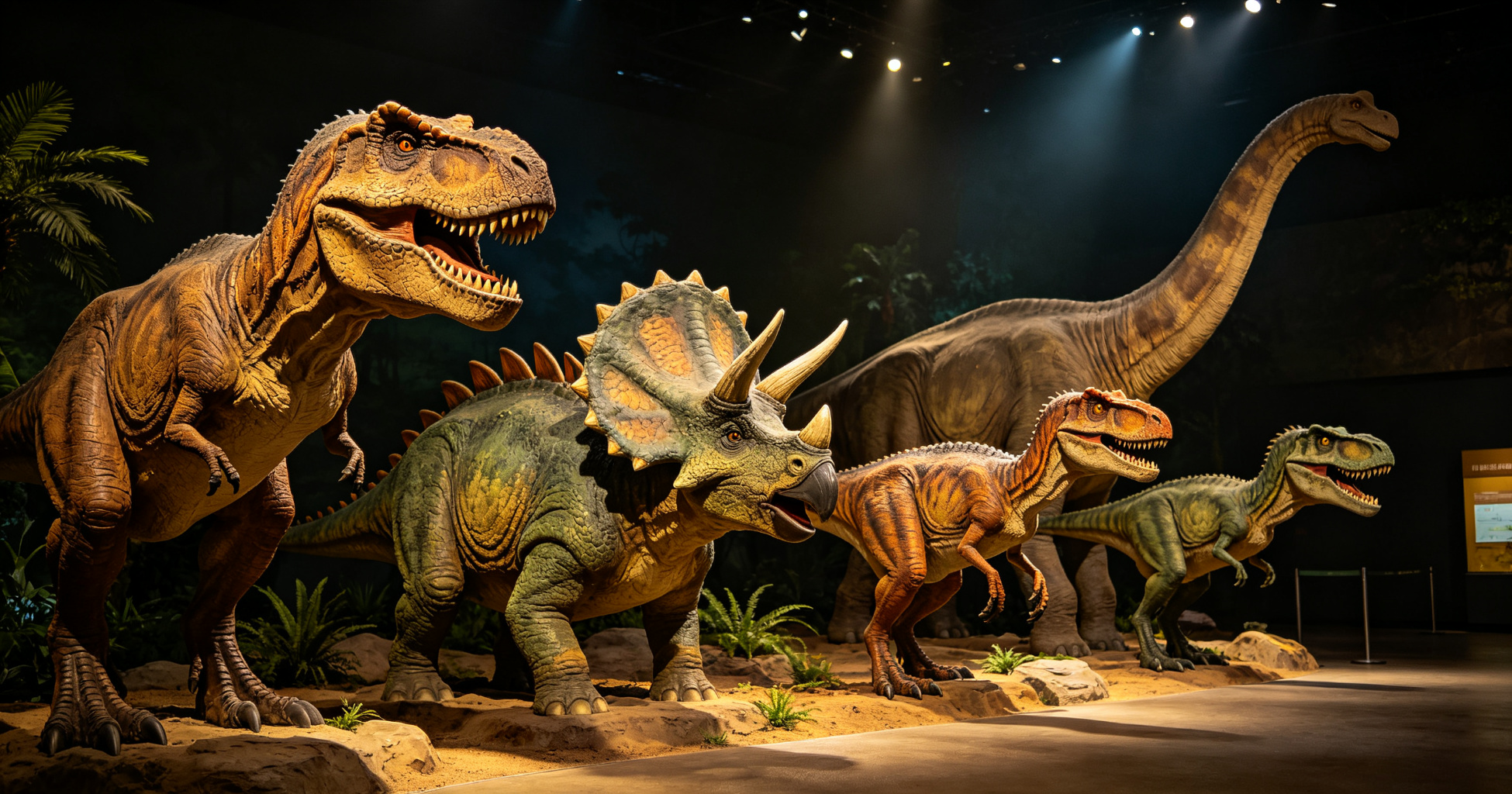
- Sauropod diversity display: Brachiosaurus (high browser), Amargasaurus (medium browser with spines), Nigersaurus (low grazer) — side by side showing the different sauropod feeding strategies. One of the most educational sauropod displays possible.
- South American dinosaur exhibit: Amargasaurus with Giganotosaurus, Carnotaurus, and other South American dinosaurs — a Gondwanan / South American themed zone.
- African dinosaur exhibit: Nigersaurus with Spinosaurus, Suchomimus, Ouranosaurus, and other African dinosaurs — an African dinosaur zone.
- Swamp / wetland scene: Amargasaurus and Nigersaurus in wetland, swamp, and river environments — both species are associated with moist, lowland habitats.
- Weird and wonderful exhibit: A collection of the strangest dinosaurs — Amargasaurus, Nigersaurus, Therizinosaurus, Dimetrodon — celebrating the diversity and weirdness of prehistoric life.
Size Ranges and Pricing
These medium-sized sauropods are more affordable than giant sauropods:
- Small (5-7m): Compact models for indoor exhibits and smaller venues. Budget: $8,000 - $18,000.
- Medium (9-12m): Life-size adults. The most popular size. Budget: $22,000 - $45,000.
- Large (13m+): Oversized models for maximum impact. Budget: $50,000 - $80,000.
Ready to Add Some Weird and Wonderful Sauropods?
If you already have classic sauropods like Brachiosaurus and Apatosaurus and want to add something different, Amargasaurus and Nigersaurus are excellent choices. They are scientifically fascinating, visually distinctive, and genuinely surprising to most visitors. Browse SAGE's unusual sauropod lineup or contact our team for custom sauropod exhibit design.