Sound is half the experience — sometimes more. A silent animatronic dinosaur, no matter how visually impressive, feels like a statue. Add the right roar, breath, and ambient sound, and suddenly it comes alive. Visitors jump, they laugh, they lean in — the emotional impact multiplies.
But not all dinosaur sound systems are created equal. A cheap speaker blaring generic "roar" sounds will make even a well-built dinosaur feel like a toy. A properly designed sound system, with carefully crafted audio, quality speakers, and precise synchronization, can make visitors forget they are looking at a machine.
What Goes Into a Dinosaur Sound System
A modern animatronic dinosaur sound system has several components working together:
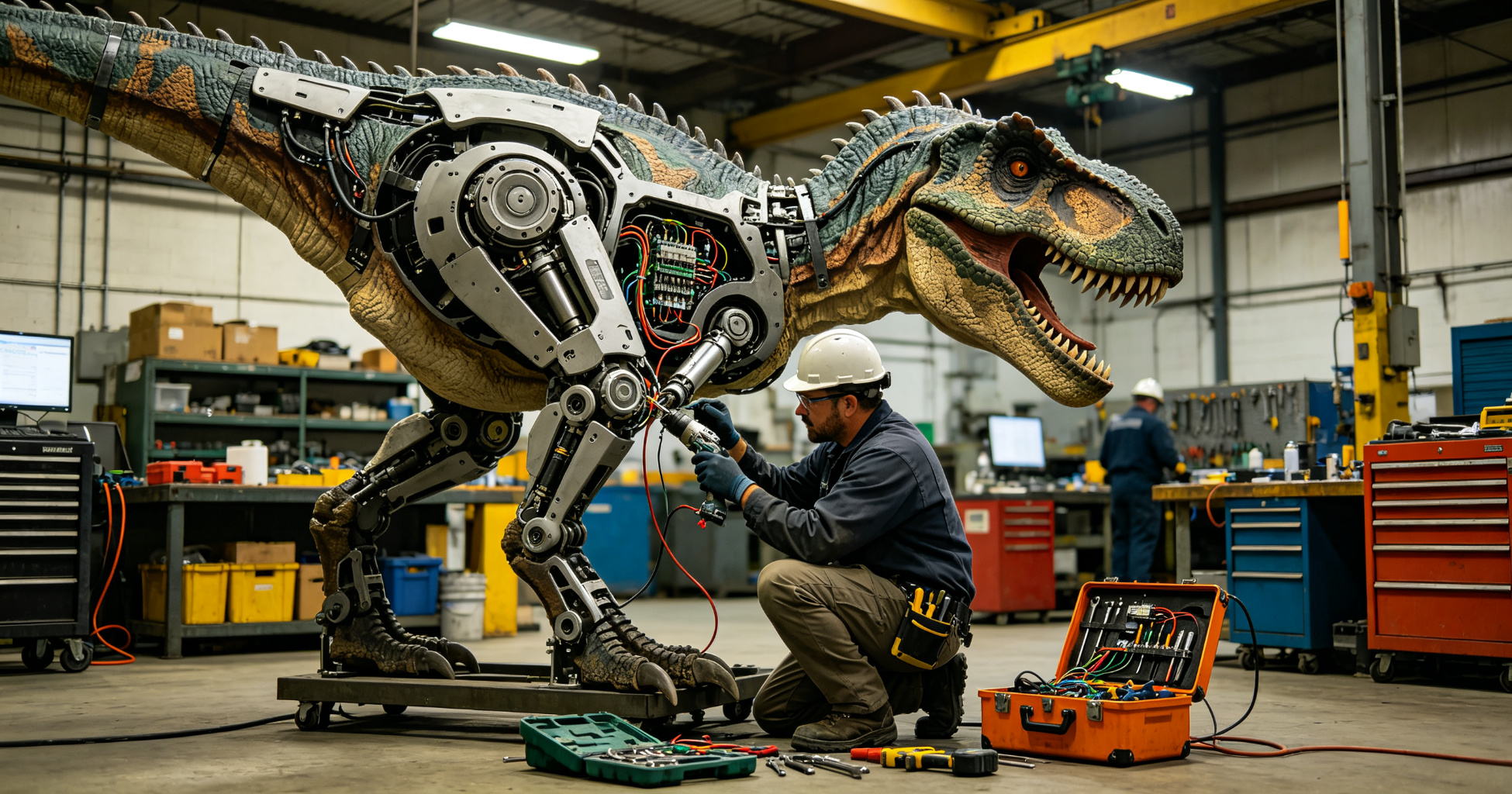
- Digital audio player: The brain of the system — stores all sound files and triggers them at the right time in sync with movements. SAGE uses industrial-grade digital players with solid-state storage for maximum reliability.
- Amplifier: Powers the speakers and provides clean, distortion-free audio output even at high volumes.
- Speakers: The output devices — typically mounted inside the dinosaur's head/chest for forward-facing sound, plus optional subwoofers for low-frequency rumble effects.
- Control interface: How sounds are triggered — through the main motion controller, IR sensors, external DMX, or remote control.
- Sound files: The actual audio recordings — specially designed dinosaur vocalizations, breath sounds, ambient effects, and optional narration.
Sound Design: How Dinosaur Voices Are Created
Nobody knows exactly what a T-Rex sounded like. But good dinosaur sound design combines paleontological research with creative sound design to produce something that is both believable and dramatically effective.
SAGE's sound designers use a combination of techniques:
- Animal recordings: The base of many dinosaur sounds comes from real animals — big cats for roars, alligators for bellows, elephants for low-frequency rumbles, birds for certain calls. These are layered, processed, and modified to create something new but biologically plausible.
- Anatomical inference: Scientists can infer something about dinosaur vocalization from the shape of their skulls, nasal passages, and (in rare cases) preserved soft tissue. Parasaurolophus, with its hollow crest, almost certainly produced resonant, trumpet-like calls.
- Size scaling: Larger animals have deeper voices. Sound designers use frequency scaling to ensure the pitch matches the animal's size — a 20m Brachiosaurus has subsonic low-end that you feel more than hear.
- Behavioral context: A dinosaur does not just roar — it has different sounds for different situations: territorial roar, contact call, hiss, breath, feeding sound, growl. The best animatronic dinosaurs have multiple sound types that make them feel alive.
Each dinosaur model in the SAGE catalog comes with its own custom sound set, not a generic "dinosaur roar" used for every species. A Triceratops sounds different from a T-Rex, which sounds different from a Velociraptor, which sounds different from a Brachiosaurus. This attention to detail is part of what makes the experience feel real.
Synchronization: The Key to Realism
Even the best sound design falls flat if it is not perfectly synchronized with the dinosaur's movements. Our brains are incredibly sensitive to audio-visual timing — even a 100-millisecond delay between a mouth opening and the sound coming out can make the whole thing feel fake.
SAGE animatronic dinosaurs use a synchronized control system where sound playback and motor control are handled by the same controller. This ensures perfect timing — the mouth opens, the roar begins, the pitch changes as the mouth opens wider, and the sound cuts off precisely when the mouth closes.
For more complex sequences, multiple sounds may play simultaneously — a breath sound in the background while the primary roar plays through the main speaker, plus a low-frequency rumble through a subwoofer. The controller orchestrates all of it in real time.
Speaker Placement and Audio Quality
Where the speakers are placed inside the dinosaur makes a big difference in how realistic the sound feels:
- Primary speaker (mouth/throat area): The main vocal speaker is typically placed in the head or upper chest area, angled forward so the sound projects from the dinosaur's mouth, just like a real animal.
- Subwoofer (chest/body): For large dinosaurs, a subwoofer placed in the body cavity adds visceral low-frequency rumble that visitors can feel in their chests. This physical sensation dramatically increases the sense of realism and impact.
- Secondary speakers: Some models have additional speakers for ambient sounds, breath effects, or directional audio from different parts of the body.
Speaker quality matters. Cheap speakers produce harsh, distorted sound at high volume and fail quickly outdoors. SAGE uses weather-resistant, high-output speakers with wide frequency response — chosen specifically for the size and species of each dinosaur model.
Sound Options and Customization
Standard dinosaur sound systems include species-appropriate roars, growls, hisses, and breath sounds. But there are many ways to customize the audio experience:
- Custom voice design: If you want your dinosaur to sound a specific way — deeper, scarier, more realistic, more movie-like — we can design custom sounds from scratch based on your reference.
- Narration and educational content: For museums and educational exhibits, the sound system can include narrated facts and information triggered by buttons or motion sensors.
- Multiple language support: Educational narration can be provided in multiple languages, selectable by switch or sensor.
- Background music and ambient soundscapes: For themed environments, the dinosaur's sound system can be integrated with background music, jungle ambient sounds, or other environmental audio.
- Volume control: All systems include volume adjustment so you can set appropriate levels for your specific environment. Some models offer multiple preset volume profiles.
- External audio integration: For stage and show environments, the dinosaur's audio can be routed through your existing sound system rather than using built-in speakers.
Sound Level Guidelines for Different Environments
Appropriate volume depends entirely on the setting. Here are our general recommendations:
- Outdoor theme park (full volume): 90-100 dB at 3m — loud enough to be dramatic and carry across the area, but below the threshold for hearing damage with intermittent exposure.
- Indoor exhibit (moderate): 75-85 dB at 3m — audible and impressive but not overwhelming in an enclosed space.
- Mall / retail (polite): 65-75 dB at 3m — attention-grabbing but not so loud that it bothers shoppers in adjacent stores.
- Museum with narration (mixed): 70-80 dB for dinosaur sounds, slightly louder for clear narration — balanced so both are intelligible.
- Restaurant (subtle): 60-70 dB at 3m — present and atmospheric but not so loud that it interferes with conversation.
Always test sound levels in the actual installation environment. Room acoustics, hard reflective surfaces, and ambient noise all affect how loud the dinosaur feels. Adjust based on the actual experience, not just the dial position.
Maintenance and Care of Sound Systems
- Keep speakers dry: While outdoor-rated speakers are water-resistant, they are not waterproof. Properly sealed speaker enclosures and drainage holes are essential.
- Check connections: Vibration from operation can loosen audio connections over time. Check speaker connections periodically.
- Clean speaker grills: Dust and dirt buildup on speaker grills affects sound quality. Clean gently with a soft brush.
- Protect amplifier electronics: The amplifier and audio player should be in a dry, ventilated location. Overheating shortens electronics life.
- Sound quality changes = check for damage: If the sound suddenly becomes distorted or muffled, it usually indicates either a damaged speaker, a loose connection, or water in the speaker enclosure. Investigate promptly.